Version 1.0, feb 2023
1. Introduction
Global Trade Item Number (GTIN) is a global solution for the supply chain. It enables the identification of any trade item that may be priced, ordered or invoiced at any point in the supply chain where there is a need to retrieve predefined information. Regardless of sector or type of trade item, the GTIN Management Standard applies.
This guidance on the management of GTINs for construction products contains construction-specific examples of the GTIN rules.
Unique identification of construction products is essential for maintaining the efficiency that stakeholders need in order to exchange product information consistently and ensure that supply chains operate smoothly. In addition, unique identification of construction products plays an important role in complying with various regulations around the world. Finally, unique identification and communication between trading partners regarding product changes are essential to ensure that the correct product reaches the store shelf or is supplied directly to the end user.
Construction products typically have long lifespans, with some remaining in active use for 50 or even 100 years. Many external factors can affect the use and value of a construction product over the course of its lifespan. Examples include construction methods, construction regulations and knowledge of the short- and long-term properties of different materials.
For construction owners and property managers, knowing what is contained within a construction has always been a challenge. However, the rapid development of new materials, together with an increased focus on sustainability and circularity, has increased the need for effective tracking of construction products, their properties and their contents throughout their entire lifecycle. To address these needs, this document provides examples of how GTINs can be managed by parties involved in the maintenance, repair, upgrading, reuse and recycling of construction products.
This document is designed to help the industry make consistent decisions regarding the unique identification of construction products in open supply chains and comply with the general GTIN Management Standard. Overall, costs are minimised when all stakeholders throughout a product’s lifecycle follow the GTIN Management Standard. This can also simplify carbon footprint calculations and support the tracking of products and their contents. In turn, this facilitates a circular economy, reuse, recycling and compliance with various green construction certification schemes.
1.1 Scope
The scope of this guidance is described below.
- This guidance covers the identification of new professional construction products used in construction and civil engineering works. This also includes professional construction products currently on the market without a GTIN, as well as unique, configured products.
- The guidance defines how GTINs SHALL be used to persistently and uniquely identify a product for all stakeholders that interact with it. These include manufacturers, retailers, contractors, property management companies and companies involved in renovation, demolition, reuse, material recycling and waste management.
The following are out of scope:
- All GS1 identification keys other than GTIN (e.g. GLN, GMN, GIAI, etc.).
- Data capture.
- Data sharing technologies.
- Trade item serialisation.
- Construction services.
- Maintenance.
- Circular economy solutions.
1.2 Guiding principles and business objectives for changing a GTIN
This document provides guidance for creating practical value for businesses and end users, particularly when predefined information changes for an existing product or when a new product is introduced for the first time. The guiding principles are described in the GTIN Management Standard.
At least one of the guiding principles must apply for a GTIN change to be required.
- Is the consumer and/or trading partner expected to distinguish the changed or new product from previous/current products?
- Is there a regulatory/liability disclosure requirement to the consumer and/or trading partner?
- Is there a substantial impact on the supply chain (e.g. how the product is shipped, stored or received)?
When these principles are applied to construction products, they are interpreted to mean that product changes affecting downstream processes (e.g. maintenance, next use, recycling or end-of-life) may result in the need for a GTIN change.
1.3 Definition of a new product versus a product change
When making decisions about product identification, it is important to understand the differences between a NEW product and changes to an existing product.
New products are products that do not currently exist within the brand owner’s product range and are new to the market. A new product should be considered an “addition” to a product range. Under the GTIN Management Standard, a new product must always be assigned a new GTIN so that the new product can be correctly distinguished from any existing product, i.e. a product that is currently available.
Changes to existing products are considered “replacement products” (the previous version will no longer exist once the replacement product has been fully introduced, as determined by the brand owner). The GTIN Management Standard defines when a change to certain attributes of an existing product requires a new GTIN.
- New product: A “new product” is defined as a product that does not currently exist or has not previously been available for sale and that is an addition to the brand owner’s portfolio/is new to the market.
- Product change: An existing product that is currently part of the brand owner’s portfolio and available on the market, whose attributes have been changed.
1.4 GS1 standards and compliance with laws and regulations
The GTIN Management Standard represents a minimum requirement. Please note that regulations in your market may be more stringent and SHALL be followed. All local legal and regulatory requirements take precedence over the GTIN Management Standard.
1.5 GTIN Management Standard and the brand owner’s right to change a GTIN
Brand owners may change GTINs as often as they consider appropriate, based on their own needs and the needs of their consumers, trading partners and other affected parties. This should be done with consideration of the guiding principles defined in the GTIN Management Standard.
2. Examples of GTIN rules for construction products
This section provides examples of GTIN rules for construction products. It specifies when a GTIN MUST be newly assigned (NEW PRODUCT) or changed (REPLACEMENT PRODUCT) in order to comply with the GTIN Management Standard.
The GTIN Management Standard defines when GTIN changes are required at the end-user trade item level (base unit) as well as for higher-level trade items (e.g. case, pallet) that currently exist and are used in distribution processes. To enable traceability after a product has reached the end user, the base level/base unit is the most important level, as this is the level linked to information about the product. This primarily applies to GTIN Management Standard rules 2.1 New product introduction and 2.2 Declared formulation or functionality.
Remember that all GTIN rules must be considered when making the final decision on whether or not to change a GTIN.
For each of the GTIN rules, a more detailed explanation of the relevant guiding principles is provided together with the hierarchical levels for GTIN assignment.
The number of hierarchical levels depends on the type of product. More information about hierarchical levels can be found in the GS1 General Specifications. An overview is also provided in Appendix A.
2.1 New product introduction
See the section of the GTIN Management Standard dedicated to new product introduction.
A “new product” is defined as a product that does not currently exist or has not previously been available for sale and that is an addition to the brand owner’s portfolio/is new to the market.
Every new product requires the assignment of a new GTIN.
Hierarchical levels for GTIN assignment
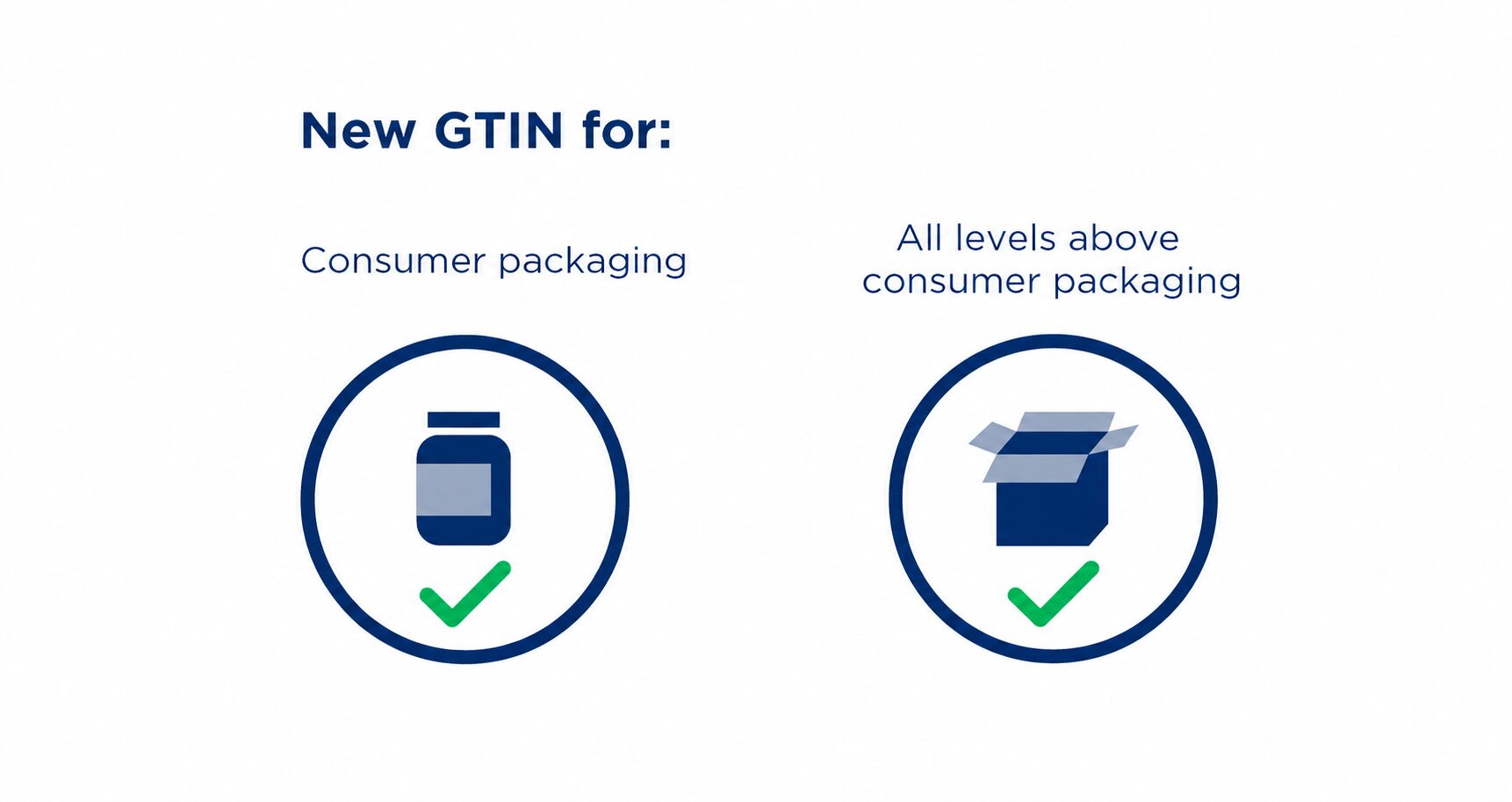
The following are examples of new construction products that require GTIN assignment:
- A construction product is manufactured that has never previously existed on the market.
- A wooden shadow moulding is updated with a new profile.
- An insulation board is changed to provide lower thermal conductivity.

New insulation with lower thermal conductivity
- An electric screwdriver now has a higher maximum torque.
- An adhesive is launched with a shorter setting time.

New adhesive with a shorter setting time
- A paint is offered in a new shade of white.
- A pre-assembled window is launched.
- A prefabricated concrete element is added to a product range.
2.2 Declared formulation or functionality
See the section of the GTIN Management Standard dedicated to declared formulation or functionality.
“Functionality” is defined as the particular use or set of uses for which something is designed. “Formulation” is defined as a list of the ingredients or components used to create a trade item.
A change to the formulation or functionality that affects the legally required declared information on a product’s packaging, and where the brand owner also expects the consumer or supply chain partner to be able to distinguish the difference, requires a new GTIN. Both conditions must be met for the assignment of a new GTIN to be required.
 Note! For the construction sector, it is also important to note that a GTIN change may be required when a change to the formulation or functionality affects downstream business processes (e.g. maintenance, next use, recycling or end-of-life).
Hierarchical level for GTIN assignment
Examples of business scenarios requiring a GTIN change:
- The appearance classification of a pine product changes from G4-1 to G4-3.
- The chemical formulation of a product is intentionally changed (not merely as a result of normal day-to-day fluctuations in the production process).
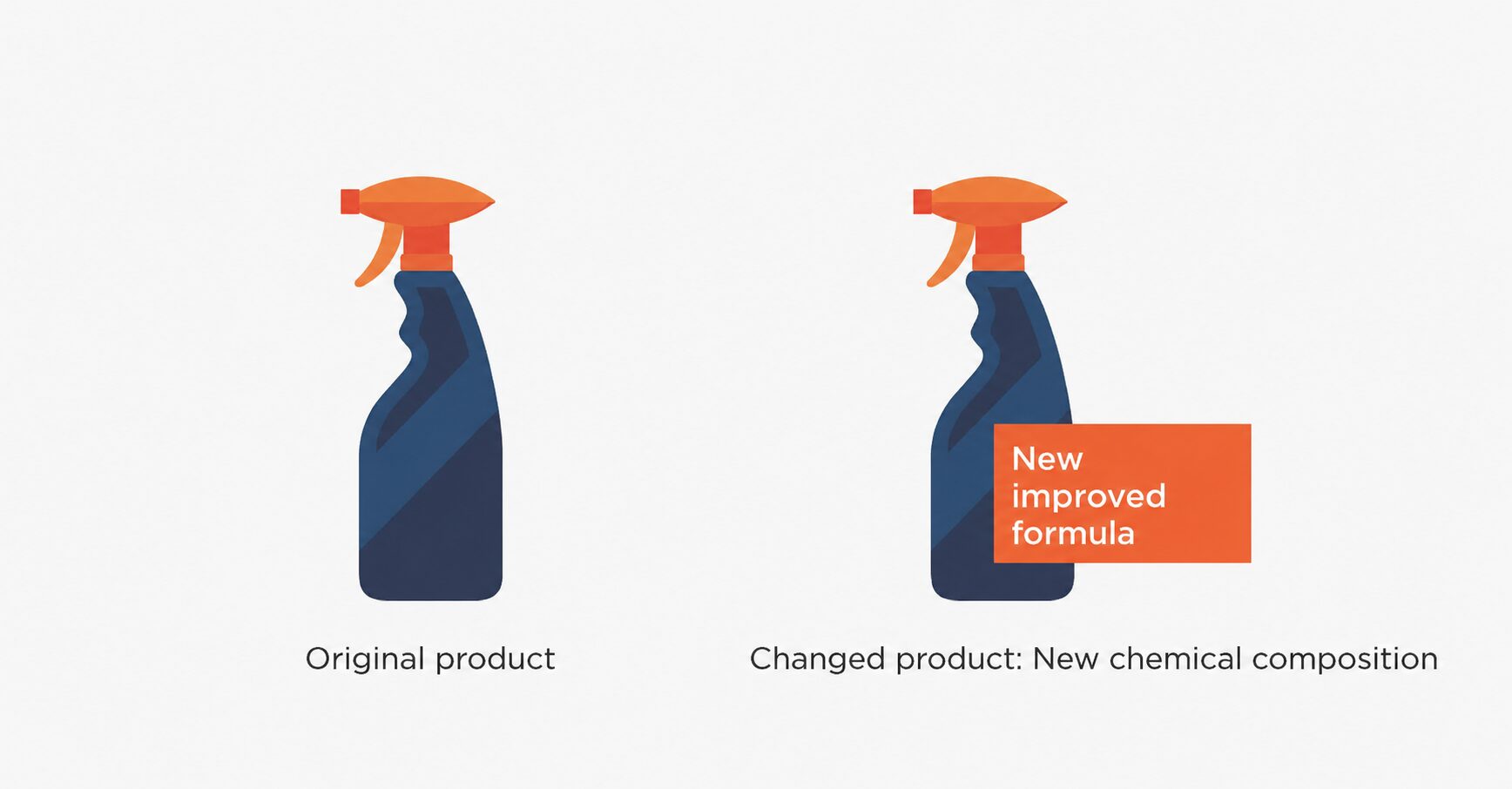
- A paint with a different chemical composition is used on a product.
- The solution or method used to impregnate a wood product is changed.

Original product: Impregnated decking

Changed product: Impregnated using a different method or chemical composition
- The type of battery in an electric screwdriver is changed.

Original product: Screwdriver with a 3 Ah battery

Changed product: Same screwdriver with an 8 Ah battery
- The density of a plasterboard is changed to enable extended use/functionality.
- The hinges on a window/door are replaced.
2.3 Declared net content
See the section of the GTIN Management Standard dedicated to declared net content.
“Net content” is defined as the amount of the consumable product contained in a package, as declared on the label, which may include net weight, volume, count, units, etc.
Any change (increase or decrease) to the declared net content stated on the packaging requires the assignment of a new GTIN.
Hierarchical level for GTIN assignment
Examples of business scenarios requiring a GTIN change:
- The net content of a paint can increases from 10 l to 15 l.

Original product: Net content 10 l

Changed product: Net content 15 l
- The declared net weight of a tube of sealant increases from 680 g (24 oz) to 794 g (28 oz).
- The declared number of plasterboards in a package changes from 8 to 10.
- The number of insulation boards in a saleable unit changes from 4 to 8.

Original product: A package containing 4 insulation boards


Changed product: The package now contains 8 identical insulation boards
- The declared number of bricks on a pallet changes (the pallet is the saleable unit).

Original product: A pallet (saleable unit) contains 216 bricks

Changed product: A pallet (saleable unit) now contains 240 of the same bricks
2.4 Dimensional or gross weight change
See the section of the GTIN Management Standard dedicated to dimensional or gross weight change.
A change of more than 20% to a physical dimension, along any axis, or to the gross weight requires the assignment of a new GTIN.
Hierarchical level for GTIN assignment
Examples of business scenarios requiring a GTIN change:
- The size of a package of glass wool insulation is reduced as a result of compression.

Original product: A package 2 m (6.6 ft) wide and 1 m (3.3 ft) in diameter containing 10 m² (107.6 ft²) of glass wool insulation

Changed product: A package 2 m (6.6 ft) wide and 0.5 m (1.6 ft) in diameter containing 10 m² (107.6 ft²) of the same glass wool insulation
- The gross weight of a product increases by 50%, from 0.34 kg (0.75 lb) to 0.68 kg (1.5 lb), because the packaging material changes from plastic to a wooden box.
- The height of a box of nails changes by 40%, from 7.6 cm (3 in) to 10.64 cm (4.2 in).
- Expanding foam is packaged in a new, larger container while retaining the same net content.

Original product: 500 ml expanding foam

Changed product: 500 ml of the same expanding foam packaged in a larger container
2.5 Add or remove certification mark
See the section of the GTIN Management Standard dedicated to adding or removing a certification mark.
A packaging change involving the addition of a new certification mark, or the removal of an existing certification mark (e.g. EU Ecolabel, FSC or PEFC), that is significant to regulatory bodies, trading partners or end consumers requires the assignment of a new GTIN.
Hierarchical level for GTIN assignment
Examples of business scenarios requiring a GTIN change:
- A product that was previously covered by a national standard is now covered by a harmonised EU standard, meaning that it must now carry CE marking and have a Declaration of Performance.


- Addition or removal of the EU Ecolabel.
- Addition or removal of an “energy efficiency” logo issued by a government-approved body.
- Addition or removal of an FSC or PEFC certification mark.
2.6 Primary brand
See the section of the GTIN Management Standard dedicated to primary brand.
The primary brand is the brand that is most recognisable to the consumer, as determined by the brand owner, and may be expressed as a logo and/or words.
A change to the primary brand displayed on the trade item requires the assignment of a new GTIN.
Hierarchical level for GTIN assignment
Examples of business scenarios requiring a GTIN change:
- The company’s primary brand changes from “Good Construction Products” to “Better Construction Products”.

The brand is “Best Floor”

The brand is now “Ultimo Floor”
2.7 Time-critical or promotional product
See the section of the GTIN Management Standard dedicated to time-critical or promotional product
A change to a product (including packaging changes) that is promoted for a specific event or date, and that affects the supply chain handling required to ensure that the trade item is available for sale during a specified period, requires the assignment of a new GTIN.
Hierarchical level for GTIN assignment
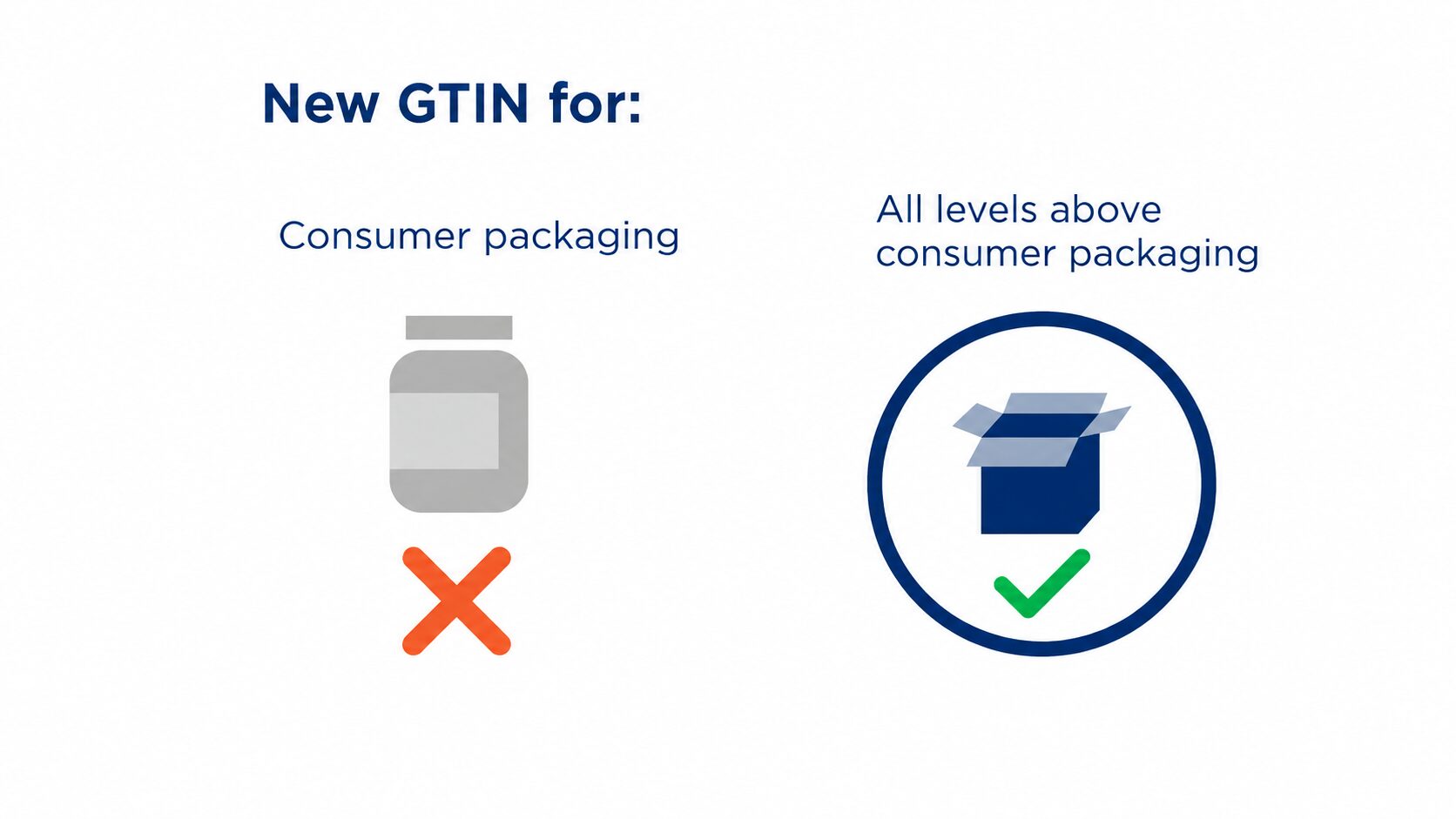
Examples of business scenarios where a unique GTIN is required at a higher packaging level (e.g. pack, case, pallet):
- A free sample (which is not identified by its own GTIN) is attached to an existing trade item during a promotional period, while the original trade item’s declared net content remains unchanged and the package dimensions or gross weight of the product do NOT change by more than 20%.
- For a two-month period, a specified portion of the proceeds from a particular product is donated to a charity. This is stated on the packaging.
- For a limited period, a battery is included with the purchase of an electric screwdriver.

Original product: Screwdriver without battery

Changed product: Same screwdriver supplied with a battery for a limited period
- A product is launched in a promotional version with the words “Special Offer” printed on the packaging.
2.8 Pack/case quantity
See the section of the GTIN Management Standard dedicated to pack/case quantity.
A change to the number of trade items in a case, or a change to the number of cases in a predefined pallet configuration, requires the assignment of a new GTIN.
Hierarchical level for GTIN assignment
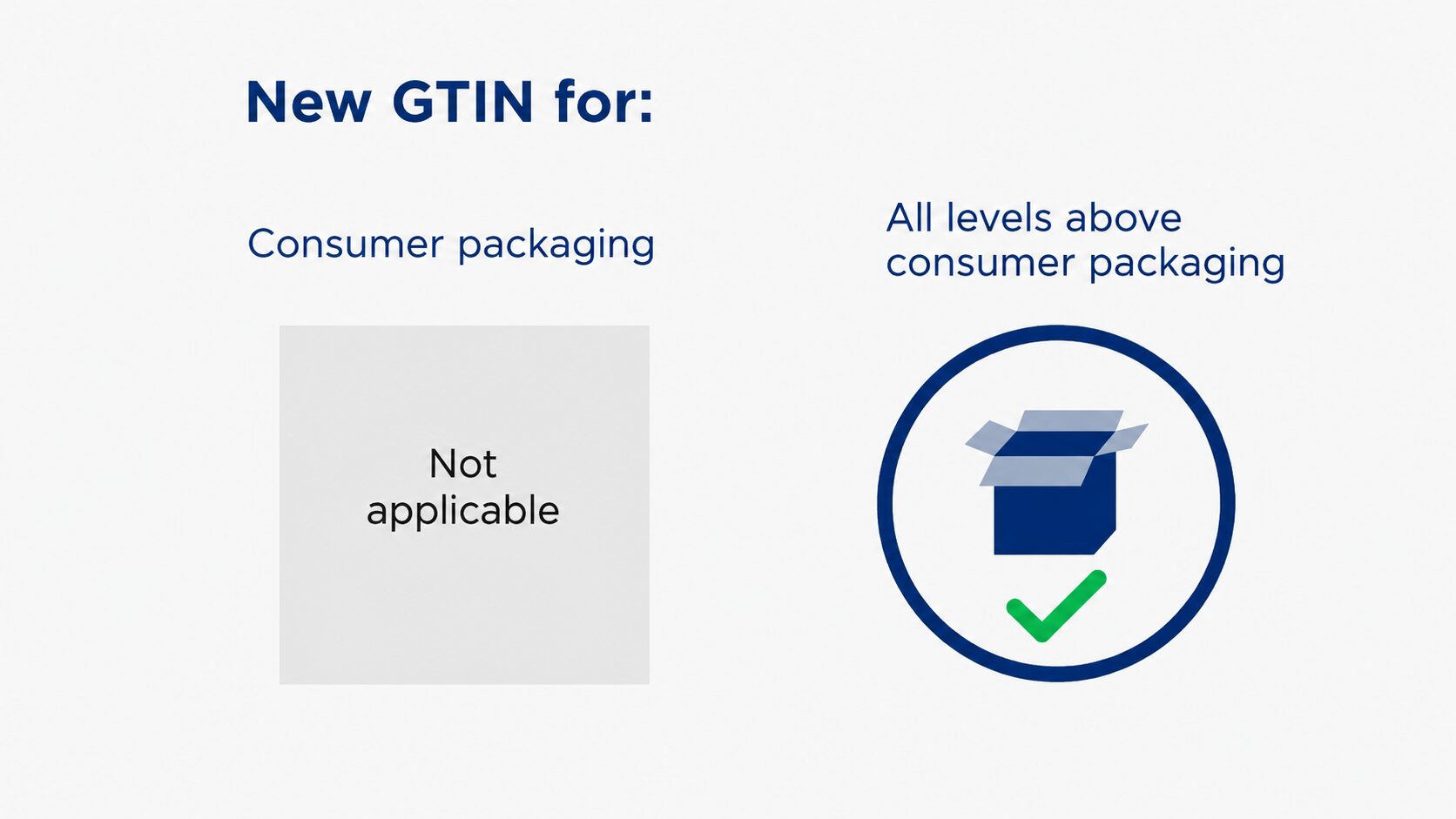
Examples of business scenarios where a unique GTIN is required at a higher packaging level (e.g. pack, case, pallet):
- A case configuration changes from containing 8 trade items to containing 12 trade items, and the case must have a unique identification.
- A pallet configuration changes from containing 100 boards to containing 120 boards, and the pallet must have a unique identification.

Original product: A pallet of boards contains 100 boards (the boards are identified with a GTIN and constitute the lowest level of saleable units)

Changed product: The pallet containing the same boards now contains 120 boards (the boards are still identified with the same GTIN and still constitute the lowest level of saleable units)
2.9 Predefined assortment
See the section of the GTIN Management Standard dedicated to predefined assortments.
A predefined assortment is defined as a package containing two or more trade items that are combined and sold together as a single trade item (also sometimes referred to as a bundle).
A change, addition or substitution of one or more trade items included in a predefined assortment requires the assignment of a new GTIN.
Hierarchical level for GTIN assignment
Examples of business scenarios requiring a GTIN change:
- A bathroom furniture package is changed so that it now also includes a tap.

Original product: A bathroom package without an included tap

Changed product: The same bathroom package with a tap
- A shower set is changed so that it no longer includes a soap holder.
- Two bits in a bit set are replaced with bits of different dimensions.
- One of the sizes in a mixed pack of screws is changed.
2.10 Price on pack
See the section of the GTIN Management Standard dedicated to price on pack.
“Price on pack” is defined as when the brand owner includes pre-pricing as part of the packaging graphics. This does not include price marking on a price label, sticker, hang tag or anything else that can be removed from the packaging or product.
Any addition, change or removal of a price marked directly on the product packaging (not recommended) requires the assignment of a new GTIN.
Hierarchical level for GTIN assignment
Examples of business scenarios requiring a GTIN change:
- The pre-printed price on a package changes from EUR 3 to EUR 2.
- A sales price of EUR 8 is added to a product’s packaging.
- The recommended retail price is set at EUR 1.99 and included in the packaging graphics.


A Hierarchical levels
The base level is the lowest level in the hierarchy. A trade item at base level is identified with a GTIN and does not contain any trade items that are themselves identified with a GTIN within this hierarchy. A base-level trade item may be contained within another trade item, which may be a case or a pallet. Examples of base-level trade items include a bag of charcoal or a bottle of adhesive.
A trade item hierarchy may contain multiple base-level trade items, for example multipacks or co-packed trade items containing different products, or where the hierarchy describes a mixed display unit.

Examples of base-level trade items
The case level is the middle level of a trade item hierarchy and is used only when there are more than two hierarchy levels. An intermediate-level trade item contains other trade items identified with a GTIN and is itself contained within a trade item identified with its own GTIN. An intermediate-level trade item may contain other intermediate-level trade items. An example of an intermediate-level trade item is a case containing 6 bottles of adhesive or a pack containing 10 boards wrapped in shrink film. There may be multiple intermediate levels in a trade item hierarchy. In some cases, the intermediate level is not used, for example when the base unit is large. One example is bags of charcoal, where the pallet is displayed directly in the store.

Examples of intermediate-level trade items
The top level is the highest level in a trade item hierarchy. A top-level trade item contains other trade items but is not itself contained within another trade item. The top level is used only when there is a top level in the hierarchy. Examples of top-level trade items include a pallet of cases containing screws or a cable drum.

Examples of top-level trade items
Example of a single-level hierarchy
This example shows a hierarchy consisting of a water heater on a pallet, which constitutes the base level. Note that this hierarchy has neither an intermediate level nor a top level, but consists only of the base level.

Example of a single-level hierarchy
Example of a two-level hierarchy
This example shows a hierarchy consisting of the following:
- Base level – bag of charcoal.
- Top level – pallet containing 36 bags of charcoal.
Note that this hierarchy has no intermediate level and consists only of the base level and top level.

Base level

Top level
Example of a two-level hierarchy
Example of a three-level hierarchy
This example shows a hierarchy consisting of the following:
- Base level – box containing 100 screws.
- Intermediate level – pack containing 6 boxes of screws.
- Top level – pallet containing 12 cases of screws.
Example of a four-level hierarchy
This example shows a hierarchy consisting of the following:
- Base level – bottle.
- Intermediate level 1 – pack containing 6 bottles, i.e. a “6-pack”.
- Intermediate level 2 – case containing four “6-packs”.
- Top level – pallet containing 24 cases.
Note that this hierarchy contains two intermediate-level trade items.

Base level

Intermediate level 1

Intermediate level 2

Top level
Example of a four-level hierarchy
Document information
| Type of information | Current value |
|---|---|
| Document name | GTIN rules for construction products |
| Document date | Feb 2023 |
| Document version | 1.0 |
Document contributors
| Name | Organization |
|---|---|
| Håkan Alkmar | Peab Sverige AB |
| David Almroth | GS1 Sweden / GS1 Construction Centre of Excellence |
| Mårten Alrenius | Sveriges Elgrossister |
| Emil Björk | Veidekke Entreprenad AB |
| Mats Björkqvist | GS1 Sweden |
| Jan Boström | SundaHus i Linköping AB |
| Stefan Eksberg | Södra Skogsägarna EF |
| Tomas Eriksson | Sandåsa Timber AB |
| Christer Green | Svenskt Trä |
| Magnus Hallberg | JM AB |
| Monna Josefsson | Mestergruppen Sverige AB |
| Hans Karlsson | VVS-Informations Data i Stockholm AB |
| Lennart Skog | NCC Sverige AB |
| Joakim Suhr | Skanska AB |
| Johan Tillenius | Mestergruppen Sverige AB |
| Fredrik Tveter | NorDan AB |