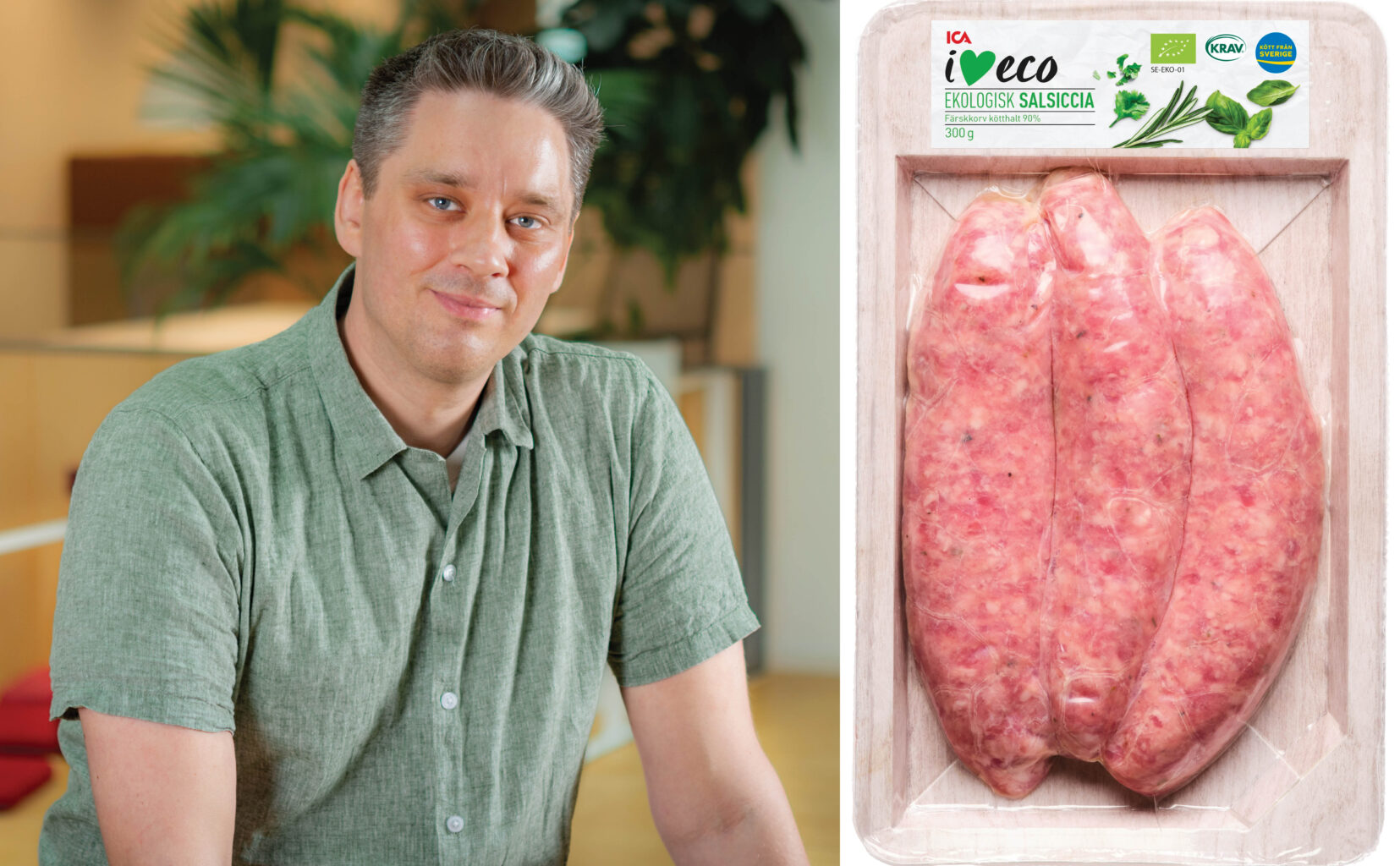
This week, ICA announced that they are now taking an important step in their transformation towards the next generation of barcodes. For the first time, the company is launching a product where the traditional barcode is completely replaced by a QR code with a GS1 Digital Link that can carry significantly more information than the traditional barcode. The product is currently being tested in ICA stores.
Private label ´ICA I love eco Fresh Salsiccia´ is the first product in Swedish grocery retail to reach stores with only a 2D barcode on the packaging. The initiative marks the start of a gradual roll-out where more products will follow, with the ambition to broaden the introduction of 2D barcodes from the beginning of 2027.

– The transition to 2D barcodes is part of a global shift in retail and FMCG to meet the growing need for more and better product information. The ambition is that by the end of 2027, POS systems worldwide will be able to read 2D barcodes in addition to today’s linear barcodes, says Alice Mukaru from GS1 Sweden, who is responsible for the 2D program in Sweden.
What is the next generation of 2D barcodes?
The next generation 2D barcodes is usually a QR code with a GS1 Digital Link or a GS1 Data Matrix. These multifunctional codes open up many new opportunities for retailers in general, but also for the store’s consumers, who get a more digital and transparent shopping experience. Already today, customers can scan the QR code with their mobile phone and access product information and in some cases also see, for example, the best-before date digitally.
– 2D barcodes are both flexible and durable, but above all, they open up the possibility of working smarter in stores with better control of, for example, dates and traceability, while giving the customer more and better information,” says Stefan Dahlgren, business developer for Private Label at ICA Sweden.
Efficient data sharing, traceability and reduced food waste
A multifunctional code that can carry much more data opens up new possibilities throughout the entire supply chain – from warehouse and logistics to store and consumer. Information no longer needs to be limited by the surface of the packaging, allowing for greater transparency and more efficient information sharing. And there are many future benefits such as better traceability, smarter expiry date management, more detailed product information and reduced food waste.
–It’s about future-proofing the range and creating better traceability. Even if not everything is immediately visible in stores, we are building a strong foundation for the future, says Stefan Dahlgren.
In the long term, the ambition is for ICA’s entire range to switch to 2D barcodes, and suppliers will also be able to print them on their packaging. A step towards a more connected and future-proof trade.